Category: Origami

  • Rowing for Hemophilia

    It’s been a crazy week for the Row for Hemophilia team. The Great Pacific Race was set to start on June 5th. If you didn’t real the earlier post, this is an endurance rowing race from California to Hawaii. One of the rowers, Jacob Pope (a rower for University of Georgia) is a hemophiliac and is using this race to raise awareness and money for the cause.

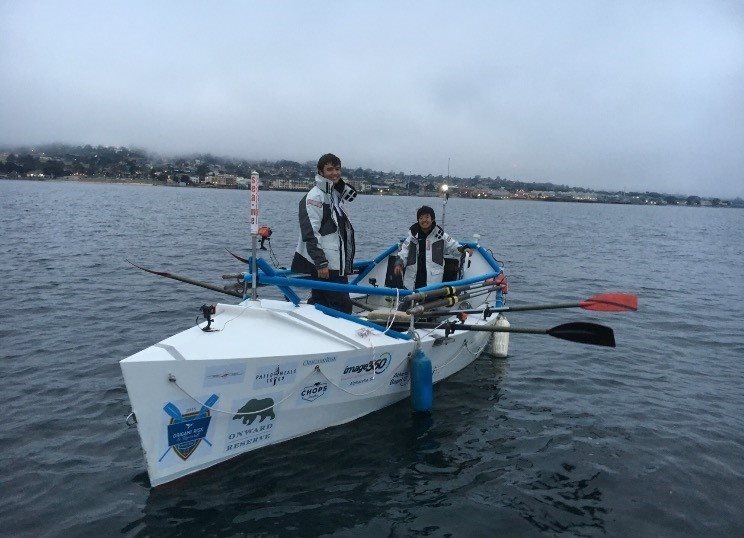
    boat

    The day before the race was to start, the race decided that they couldn’t participate because Jacob is a hemophiliac. Which they knew about. Which was the whole point.

    You can imagine their frustration. They’ve trained for a year, prepared a boat for a 40-80 day row and suddenly they aren’t allowed to do it.

    But they are a determined pair, so they just got busy.

    They organized the same safety precautions that the race was offering. They got Coast Guard approval. They got approval from both harbor masters. They changed the registry of their boat (recently purchased from the race director) to the US because the Coast Guard gives US vessels priority. They arranged for GPS tracking.

    It took a while, but a week later, they were ready to do it on their own.

    They left about 3AM Pacific Time today. So the rest of the race has about a six day head start. You can see their position here, though it may be several hours behind (the map updates 7 times a day).

    Will they pull it off? Who knows. Rowing to Hawaii is pretty much crazy by definition. But I’ll be following and cheering.

    https://www.facebook.com/rowforhemophilia/

  • Row, Row, Row Your Boat

    Our company, Origami Risk, is sponsoring a rather unusual endeavor. Last summer we had a few interns from the University of Georgia. Some are now working for us full time.

    One of them is planning to row from California to Hawaii.

    Jacob Pope is a rower on the UGA rowing team. He’s also a hemophiliac. With his best friend and fellow rower Chris Lee, he is raising money and awareness for hemophilia by rowing for a month or so. Straight.

    This is a real thing. The Great Pacific Race brings teams from around the world to row 2,400 miles. It takes from 30-80 days depending on the crew and the weather. You live in your boat. And these boats aren’t big.

    If they pull it off, they will be the youngest team to do it, and Jacob will be the first hemophiliac to complete the journey. Of course, they don’t just want to finish, they want to win.

    It’s crazy, dangerous, inspiring, all of the above. If you want to contribute, you can do so here. Origami Risk is in for $25K.

    The race starts on June 4th. I wish them strength and luck, they’ll need both.

  • Best RMIS

    RMIS is an insurance technology acronym for Risk Management Information System. It refers to risk management in the insurance sense (as opposed to the finance world). It’s a small market and there are a small number of key products.

    I am biased, as I helped start one of them, Origami Risk. I obviously think Origami Risk is the best RMIS.

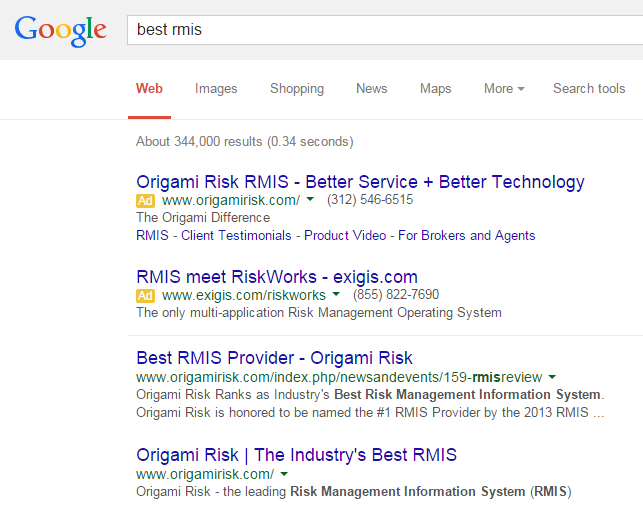
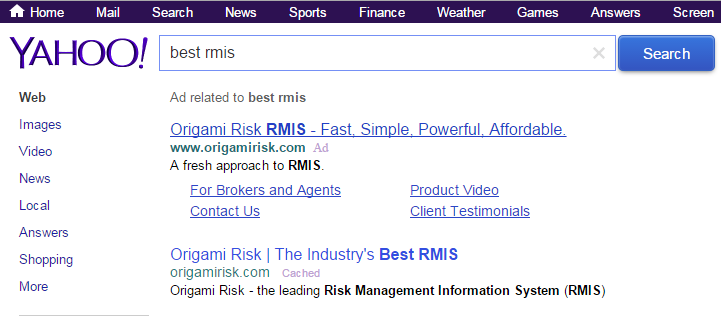
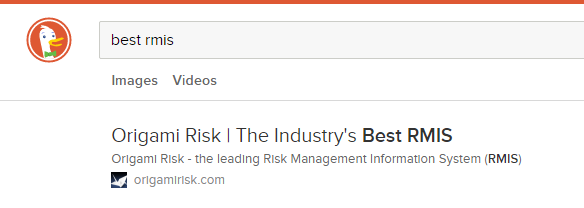
    Search engines, however, are neutral. Here are the top results from various searches on “best RMIS” (for some searches, ads are at the top):

    Google:

    GoogleBestRMIS

    Bing:

    BingBestRMIS

    Yahoo:

    YahooBestRMIS

    DuckDuckGo:

    DuckDuckGoBestRMIS

    I’ve always said Origami Risk was the best RMIS. Now every search engine says the same…

  • Bragging

    We had a NY/ Philly company holiday party today that started with bowling.

    I’m not a bowler. I bowl once in a blue moon. But this was a fun group to bowl, hang out, and drink beer with.

    First game I was lame. Broke 100, so not horrible, but barely. Second game I got in a groove.

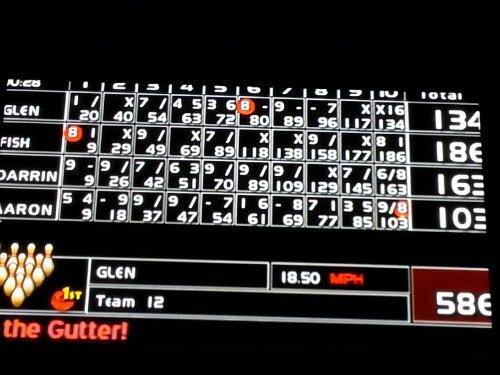
    Strike or spare in frames 2-9. I bowled a 186 (I am Fish below). More than 20 pins over my all time high. Crazy.

    image

  • Origami Risk is #1

    Dave Tweedy is the most prominent consultant in the Insurance Risk Management Software niche. Every year he publishes a review of RMIS (Risk Management Information System) Vendors.

    This year the top vendor was Origami Risk. We rock.

    The top 5 (like golf, low score is best)

    Vendor Score
    Origami Risk 1.50
    Riskonnect 1.62
    CS STARS 1.75
    Aon Risk Console 1.81
    Risk Sciences Group 1.84

    To download the review, click here.

  • Origami Risk on Top of the World

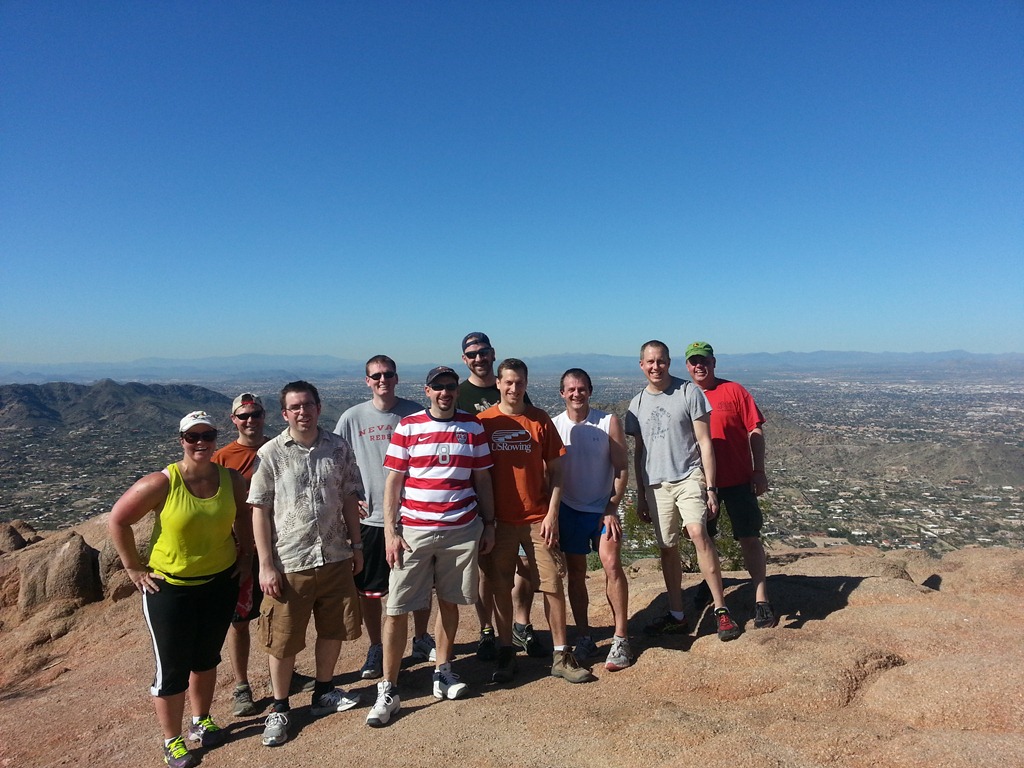
    Well, on top of a mountain anyway. During our annual company meeting, a portion of the Origami team climbed Camelback Mountain in Phoenix. It was a gorgeous day and a great hike.

    20130312_152005

  • RIMS 2012

    For those not in the insurance industry (it’s ok, you can admit it) RIMS stands for Risk and Insurance Management Society and is the pre-eminent insurance risk management organization.

    RIMS holds a conference every year. In the insurance industry, it’s a big deal. And for an insurance software vendor like Origami Risk, it is an important place to show your stuff.

    As an aside, we have serious acronym confusion here. Origami Risk has the best Risk Management Information System (RMIS) on the planet (according to this blog). So we were showing our RMIS at RIMS.

    This year’s RIMS conference was in Philly. Maybe not the sexiest location, but easy to get to so there was a nice turnout.

    Origami had a tremendous conference. The buzz around Origami was clear as the booth had constant traffic. The best part was how many people came by not because of an appointment but because they had heard so many good things about us.

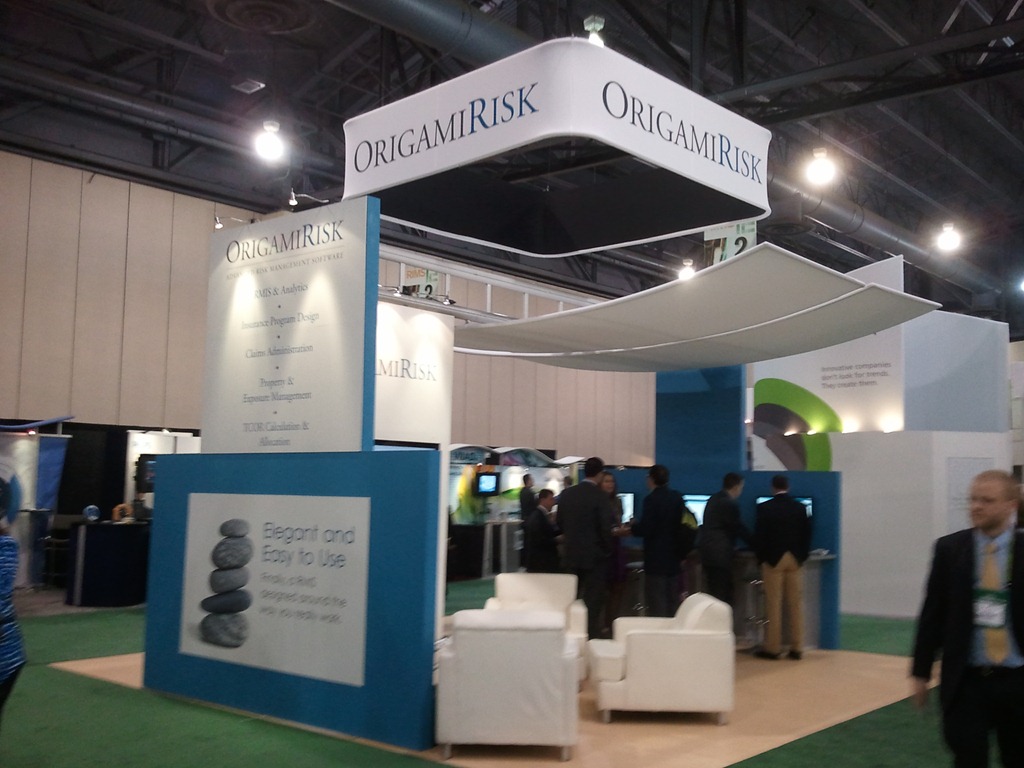
    A couple of pictures. One a tad blurry:

    2012-04-17 11.52.08

    And one clear, before the floor opened (with some of our sales team)

    image003

    Origami Risk was clearly the RMIS to beat at this year’s RIMS.

  • Private Cloud

    I’ve always argued it was an oxymoron, but Tim Bray has a better quote:

    This whole “Private Cloud” notion is a conspiracy between CIOs who think they can do a better job securing data than professional shared-services operators (uh huh), and systems vendors who love the idea of selling enterprises way more hardware than they’ll ever need at one time, so they have the heavyweight infrastructure you need to support lightweight deployment.

    He’s right. Not an oxymoron, just a way to get you to spend more money for less.

    Stick with the regular cloud

  • Warm Origami

    Origami Risk held a company meeting this week in sunny Florida. We’ve hired so many people in so many places that getting everyone together was a big deal. And it was big fun.

    We stayed here, which was awesome. We had some great strategy sessions. We did some fishing. For the record the Origami team is much better at RMIS than fishing, but a good time was had by all.

    Most importantly, we set the stage for a fantastic year. 2011 was a great year for Origami Risk. 2012 will be an exceptional one.

  • “The Cloud” is Now Meaningless

    I guess it was inevitable. It started with “Cloudwashing” where PR folks started calling everything the cloud. Now we are to the point where the “cloud” simply means “not on my computer”.

    When Aon eSolutions claims to be “the original cloud provider to the risk insurance and safety community” you know the term cloud has no real meaning.

    I guess it should be flattering to Origami. At first, competitors were telling prospects not to use us because the cloud is scary. Now they are saying they’ve been cloud all along.

    But cloud computing has real meaning. It’s about being able to harness resources on the fly with drastically reduced costs.

    Here’s a simple example. Microsoft is close to releasing the new version of SQL Server, “Denali”. Everyone is excited about the new capabilities. There’s a release candidate out there to test. But it’s a bit of a pain to buy a new server, install Windows and everything else and then install Denali.

    Amazon and Microsoft got together so that Amazon EC2 can offer a pre-built image of Denali. So we can bring up a Denali server to test with a click at minimal cost. That’s the cloud.

    I always go back to Werner Vogels description of the key benefits of a true cloud. His point was that if your “cloud” doesn’t have these benefits then it’s not a cloud:

    The cloud:

    • Eliminates Cost. The cloud changes capital expense to variable expense and lowers operating costs. The utility-based pricing model of the cloud combined with its on-demand access to resources eliminates the needs for capital investments in IT Infrastructure. And because resources can be released when no longer needed, effective utilization rises dramatically and our customers see a significant reduction in operational costs.
    • Is Elastic. The ready access to vast cloud resources eliminates the need for complex procurement cycles, improving the time-to-market for its users. Many organizations have deployment cycles that are counted in weeks or months, while cloud resources such as Amazon EC2 only take minutes to deploy. The scalability of the cloud no longer forces designers and architects to think in resource-constrained ways and they can now pursue opportunities without having to worry how to grow their infrastructure if their product becomes successful.
    • Removes Undifferentiated “Heavy Lifting.”The cloud let its users focus on delivering differentiating business value instead of wasting valuable resources on the undifferentiated heavy lifting that makes up most of IT infrastructure. Over time Amazon has invested over $2B in developing technologies that could deliver security, reliability and performance at tremendous scale and at low cost. Our teams have created a culture of operational excellence that power some of the world’s largest distributed systems. All of this expertise is instantly available to customers through the AWS services.

    Of course, Origami doesn’t really argue that our product is better because it’s in the cloud. Sure, we do derive the above benefits from being in the cloud.

    But we’re winning because Origami is just a better product.