Category: Technology

  • All About Sound

    Wait But Why has a “mini” post titled “Everything You Should Know About Sound”. It starts:

    I’ve always been a little confused about sound. So for “Tuesday’s” “mini” post, I decided to do something about that.

    He then proceeds, in classic Wait But Why style, to do an incredibly thorough  explanation of the physics of sound in an easy to understand manner. But my favorite part is this:

    I was about to move on, but sorry, I can’t get over this. The next time you’re talking to someone, I want you to stop and think about what’s happening. Your brain has a thought. It translates that thought into a pattern of pressure waves. Then your lungs send air out of your body, but as you do that, you vibrate your vocal chords in just the right way and you move your mouth and tongue into just the right shapes that by the time the air leaves you, it’s embedded with a pattern of high and low pressure areas. The code in that air then spreads out to all the air in the vicinity, a little bit of which ends up in your friend’s ear, where it passes by their eardrum. When it does, it vibrates their eardrum in such a way as to pass on not only the code, but exactly where in the room it came from and the particular tone of voice it came with. The eardrum’s vibrations are transmitted through three tiny bones and into a little sac of fluid, which then transmits the information into electrical impulses and sends them up the auditory nerve and into the brain, where the information is decoded. And all of that happens in an eight of a second, without any effort from either of you. Talking is a miracle.

    Indeed.
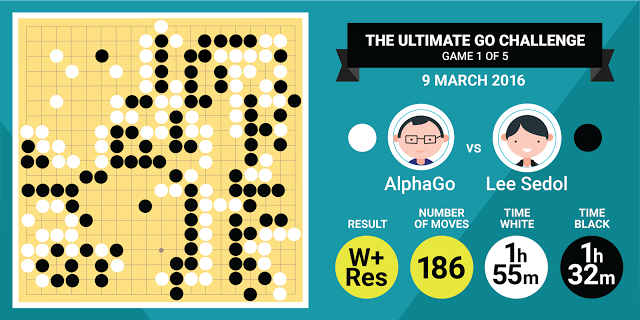
  • AlphaGo up 1-0

    For those interested in cutting edge artificial intelligence, DeepMind’s AlphaGo program beat the world’s best Go player in the first of 5 games.

    Next game is tonight (or tomorrow in Korea).

  • Who Has a Billion Users?

    There are 12 apps with 1 billion users. Google has 7 of them. But Microsoft has the only ones people actually pay for. For Microsoft it took over 20 years to get there. Android was the fastest at 5.8 years.

    (click to enlarge)

  • Oculus Rift Not Coming to Macs

    Mac users won’t be able to run Oculus Rift when the long-awaited virtual reality headset starts shipping later this month.
    When asked by GamerHubTV whether Oculus, which requires a connected Windows computer to work, would ever support Apple desktops, Oculus founder Palmer Luckey replied: “That is up to Apple. If they ever release a good computer, we will do it.”

    Ouch.

  • Supporting Apple

    Via Daring Fireball (via WSJ which has a firewall):

    Several tech companies, including Google parent Alphabet Inc., Facebook Inc. and Microsoft Corp., plan to file a joint motion supporting Apple Inc. in its court fight against the Justice Department over unlocking an alleged terrorist’s iPhone, according to people familiar with the companies’ plans.

    FBI vs. the whole tech world. Get used to it.

  • Super Awesome Geeky Stuff

    If you haven’t heard, the only part of Einstein’s theory of relativity that hadn’t been proven, finally was. Yes, Einstein rocks and not just because of his hair. And the scientists who did this will be getting the Nobel Prize soon.

    I won’t even try to explain gravitational waves and black holes and how they did it. This is a good start:

  • Tech Humor?

    The Crunchy Awards are billed as the tech version of the Oscars. Chelsea Peretti (who I had never heard of before) was the MC.

    <

    And while she sounds nervous, she’s funny. I can’t tell if the sound is bad in the recording or if the tech audience just doesn’t laugh. As a tech guy, I’m going with the latter…

    I’m being paid in Bitcoin for this event, is that a good thing?

    Apple is nominated in the new hardware category for making a pencil. Apple, are y’all even trying anymore?

    There’s a big battle between Uber and Lyft. If this were basketball Lyft would be the Clippers and Uber would be Kobe Bryant because of all the rape stuff…

    It’s not Letterman, but c’mon…

  • Lego Airplane

    Well, Lego folds the airplane…

  • Cool or Creepy?

    The amount of interesting data being collected all the time is both amazing and scary.

    Uber just posted an article listing the top 15 NYC restaurant destinations for Uber users over a week. Uber should really be able to spot trends and new hot places fairly easily. Cool and creepy all at the same time.

    My main conclusion from the article is that Uber users have money. Those are some pricey restaurants…

  • AlphaGo: Mastering the Ancient Game of Go

    This is a big step for artificial intelligence.

    The folks at Google have created a program that can compete at the elite level in Go. If you aren’t familiar with Go, it has a level of complexity greater than chess:

    The search space in Go is vast — more than a googol times larger than chess (a number greater than there are atoms in the universe!). As a result, traditional “brute force” AI methods — which construct a search tree over all possible sequences of moves — don’t have a chance in Go. To date, computers have played Go only as well as amateurs. Experts predicted it would be at least another 10 years until a computer could beat one of the world’s elite group of Go professionals.

    That prediction was less than 2 years ago, so a bit off.

    So how strong is AlphaGo? To answer this question, we played a tournament between AlphaGo and the best of the rest – the top Go programs at the forefront of A.I. research. Using a single machine, AlphaGo won all but one of its 500 games against these programs. In fact, AlphaGo even beat those programs after giving them 4 free moves headstart at the beginning of each game. A high-performance version of AlphaGo, distributed across many machines, was even stronger.

    So on to the next challenge:

    It seemed that AlphaGo was ready for a greater challenge. So we invited the reigning 3-time European Go champion Fan Hui — an elite professional player who has devoted his life to Go since the age of 12 — to our London office for a challenge match. The match was played behind closed doors between October 5-9 last year. AlphaGo won by 5 games to 0 — the first time a computer program has ever beaten a professional Go player.

    Next AlphaGo will play the top Go player in the world. But regardless of the outcome, this is a really big deal that will span far beyond gaming.

    We are thrilled to have mastered Go and thus achieved one of the grand challenges of AI. However, the most significant aspect of all this for us is that AlphaGo isn’t just an ‘expert’ system built with hand-crafted rules, but instead uses general machine learning techniques to allow it to improve itself, just by watching and playing games. While games are the perfect platform for developing and testing AI algorithms quickly and efficiently, ultimately we want to apply these techniques to important real-world problems. Because the methods we have used are general purpose, our hope is that one day they could be extended to help us address some of society’s toughest and most pressing problems, from climate modelling to complex disease analysis.